MOTOSHARE 🚗🏍️
Turning Idle Vehicles into Shared Rides & Earnings

From Idle to Income. From Parked to Purpose.
Earn by Sharing, Ride by Renting.
Where Owners Earn, Riders Move.
Owners Earn. Riders Move. Motoshare Connects.

With Motoshare, every parked vehicle finds a purpose. Owners earn. Renters ride.
🚀 Everyone wins.

Start Your Journey with Motoshare

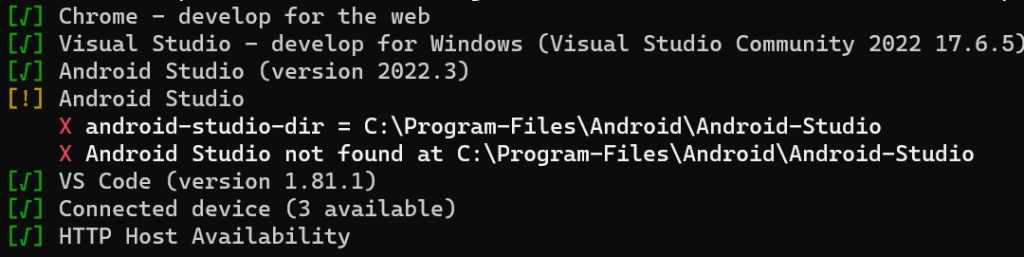
Flutter Doctor Error: android-studio-dir =

Android Studio
X android-studio-dir = C:\Program-Files\Android\Android-Studio
X Android Studio not found at C:\Program-Files\Android\Android-Studio

When configuring Flutter with Android Studio, you may have encountered a situation where you attempt to fix a problem using the following command:

flutter config --android-studio-dir = C:\Program Files\Android\Android Studio

The intention behind this command is to set the Android Studio directory for Flutter. However, if you observe closely, an issue arises due to those pesky empty spaces in the directory path, which breaks the tree structure. This seemingly simple problem can lead to considerable frustration.

Fortunately, there’s a straightforward solution to this problem. Instead of wrestling with spaces and complex directory paths, you can reset the default Android Studio directory by executing the following command:

flutter config --android-studio-dir=""

This command essentially sets the Android Studio directory to an empty string, which tells Flutter to use its default path. By doing so, you sidestep the issue of empty spaces interfering with your configuration. When you set the Android Studio directory to an empty string as shown in the command above, Flutter understands that it should rely on its built-in logic to locate Android Studio. This default behavior accounts for various system configurations, including those with spaces in directory paths, ensuring a hassle-free development experience.

Related Posts

Become SRE Foundation Certified for Modern DevOps Teams

Introduction: Problem, Context & Outcome Modern software systems operate in complex, fast-changing environments built on cloud platforms, microservices, containers, and CI/CD pipelines. Engineering teams deliver features faster…

Become an SRE Certified Professional for Modern DevOps

Introduction: Problem, Context & Outcome Modern software systems run continuously across cloud platforms, microservices, and distributed infrastructures. Engineering teams frequently struggle with outages, slow incident response, alert…

Become a Site Reliability Engineer for Modern DevOps

Introduction: Problem, Context & Outcome Modern digital services must remain available at all times, yet many engineering teams struggle with outages, performance degradation, and slow recovery during…

Become a Selenium with Java Automation Tester

Introduction: Problem, Context & Outcome Software engineering teams release features frequently, but many still struggle to maintain application quality at speed. Manual testing slows delivery cycles, introduces…

Become a Red Hat OpenShift Administration Specialist

Introduction: Problem, Context & Outcome Modern engineering teams deploy applications faster than ever, but many struggle to manage container platforms reliably at scale. Kubernetes environments grow complex…

Become an Ansible Expert for Enterprise Infrastructure

Introduction: Problem, Context & Outcome Modern IT teams face constant challenges managing infrastructure consistency, deployment speed, and operational reliability. Manual configurations, shell scripts, and environment-specific setups often…

0 0 votes
Article Rating
Subscribe
Notify of
guest
0 Comments
Oldest
Newest Most Voted
Inline Feedbacks
View all comments
0
Would love your thoughts, please comment.x
()
x