MOTOSHARE 🚗🏍️
Turning Idle Vehicles into Shared Rides & Earnings

From Idle to Income. From Parked to Purpose.
Earn by Sharing, Ride by Renting.
Where Owners Earn, Riders Move.
Owners Earn. Riders Move. Motoshare Connects.

With Motoshare, every parked vehicle finds a purpose. Owners earn. Renters ride.
🚀 Everyone wins.

Start Your Journey with Motoshare

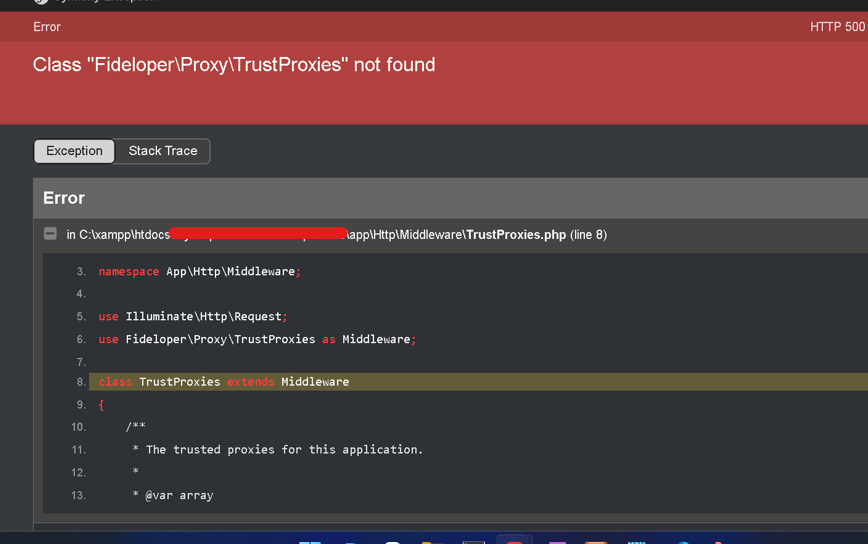
Laravel Error: Class “Fideloper\Proxy\Trust Proxies” not found

If you’ve encountered the error “Class ‘Fideloper\Proxy\Trust Proxies’ not found” in your Laravel application, fear not – you’re not alone. This common error typically stems from misconfigurations or missing dependencies within your project.

The error message suggests that Laravel is unable to locate the class ‘Fideloper\Proxy\Trust Proxies,’ specifically in the TrustProxies.php file within the app\Http\Middleware directory. This class is essential for handling trusted proxy configurations, which are crucial for security and performance in Laravel applications.

Possible Causes

Missing Dependency: The most common reason for this error is that the required package, fideloper/proxy, is not installed in your Laravel project.

Autoloading Issue: The Composer autoloader may not have been updated, preventing Laravel from finding the required class.

Solution

Install the fideloper/proxy Package

Open your terminal, navigate to your project directory, and run the following Composer command:

composer require fideloper/proxy

This command installs the package and updates your composer.json and composer.lock files.

Update Composer Autoloader

After installing the package, make sure to update the Composer autoloader to include the new class. Run the following command in your terminal:

composer dump-autoload

This command rebuilds the Composer autoloader, ensuring that it recognizes the newly installed package.

Verify Configuration

Open the app\Http\Kernel.php file and ensure that the TrustProxies middleware is added to the $middleware array:

protected $middleware = [
    // ...
    \Fideloper\Proxy\TrustProxies::class,
];

Also, check the TrustProxies.php file in the app\Http\Middleware directory. The class should extend Middleware:

use Fideloper\Proxy\TrustProxies as Middleware;

class TrustProxies extends Middleware
{
    // ...
}

Clear Configuration Cache

Laravel caches configuration files for better performance. Clear the configuration cache using the following command:

php artisan config:clear

Related Posts

Why You Need HashiCorp Terraform Training for Your Career

Terraform lets teams build and change cloud setups safely using code files. The HashiCorp Terraform training & certification program gives 15 hours of hands-on to master IaC basics for…

How to Become a Google Cloud Professional DevOps Engineer

Google Cloud grows fast as a top cloud choice, but mastering its DevOps needs real skills. The Google Cloud Professional Engineer training gives 50-60 hours of hands-on to build…

Start Your Journey with GitOps Essential Training Today

GitOps makes putting apps on Kubernetes simple and safe by using Git as the main guide. The GitOps Essential Training shows you how to set up auto deploys with…

Your Guide to Earning the FinOps Foundation Certification

Cloud spending can grow fast without good control, but smart management keeps costs in check. The FinOps Foundation Certification teaches simple ways to track, cut waste, and plan budgets…

Your Guide to ISTIO and Envoy Certification Training Success

Service meshes like Istio make handling traffic between apps easy and safe. The ISTIO Envoy Certification Training teaches you to control routing, security, and monitoring without changing your code.​…

Docker Certified Associate: Your Complete Guide to Success

Containers change how teams build and run apps smoothly across any setup. The Docker Certified Associate certification gives you the skills to handle Docker like a pro, fixing the…

5 1 vote
Article Rating
Subscribe
Notify of
guest
0 Comments
Oldest
Newest Most Voted
Inline Feedbacks
View all comments
0
Would love your thoughts, please comment.x
()
x