MOTOSHARE 🚗🏍️
Turning Idle Vehicles into Shared Rides & Earnings

From Idle to Income. From Parked to Purpose.
Earn by Sharing, Ride by Renting.
Where Owners Earn, Riders Move.
Owners Earn. Riders Move. Motoshare Connects.

With Motoshare, every parked vehicle finds a purpose. Owners earn. Renters ride.
🚀 Everyone wins.

Start Your Journey with Motoshare

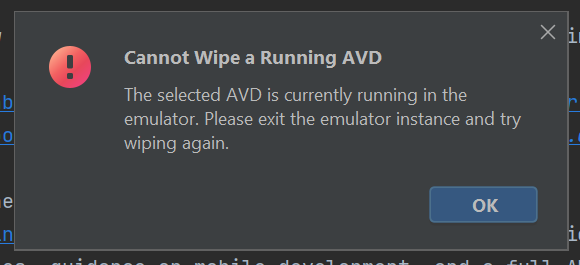
Cannot Wipe a Running AVD

Android Virtual Devices (AVDs) are essential tools for app developers as they allow for the emulation of various Android device configurations for testing and debugging purposes. However, sometimes, you may encounter a common issue where you cannot wipe or delete a running AVD through the Android Studio interface. This situation can be frustrating, but it can be resolved with a straightforward solution.

The solution to this problem involves manually deleting the AVD files and folders from your system. Follow these steps to successfully delete a running AVD:

Close Android Studio: Before you can make any changes, ensure that Android Studio is completely closed. Save your work and exit the program.

Locate the AVD Folder: Navigate to the folder on your computer where Android Studio stores AVD data. By default, the AVD folder is located in the following directory:

Example:

C:\Users\YourUsername\.android\avd

Replace “YourUsername” with your actual Windows username.

Delete AVD Files and Folders: Inside the AVD folder, you’ll find various subfolders and files, each corresponding to a different AVD configuration. Select the folder or folders that correspond to the AVD(s) you want to delete.

Restart Android Studio: After you’ve deleted the necessary files and folders, restart Android Studio. This step is crucial to ensure that the changes take effect.

Create a New AVD: Open the Android Virtual Device Manager in Android Studio. You should now see that the previously running AVD(s) have been removed. Android Studio will prompt you to create a new AVD from scratch or import an existing one if needed.

Related Posts

Implementing MLOps for Machine Learning Models in India

If you work with machine learning in cities like Bangalore, Hyderabad, or Chennai, you know it’s not just about building smart models. The real challenge starts when…

Building MLOps for Machine Learning Across Canada

If you’re working with machine learning in Canada’s tech hubs—from the bustling innovation centers of Toronto and Vancouver to the growing scenes in Ottawa, Montreal, and Calgary—you’ve…

Understanding Microservices Architecture for Developers in Bangalore

Hey there! If you build or work with software in Bangalore, you’ve probably heard people talking about microservices. Maybe your team is thinking about switching to this…

Mastering Build Automation: A Deep Dive into Maven and Its Essential

Hey there! Have you ever felt stuck trying to manage a big software project? Maybe you’ve spent hours fixing errors because something worked on your computer but…

Master Makefiles: Automate Your Development Workflow

In the world of software development and DevOps, efficiency is paramount. One of the most powerful, yet often overlooked tools for achieving this efficiency is the humble…

Master Linux: Your Foundation for Modern Technology Careers

In today’s rapidly evolving technology landscape, Linux Training has become more essential than ever. From cloud infrastructure and DevOps environments to cybersecurity and enterprise servers, Linux serves as the…

0 0 votes
Article Rating
Subscribe
Notify of
guest
0 Comments
Oldest
Newest Most Voted
Inline Feedbacks
View all comments
0
Would love your thoughts, please comment.x
()
x